Description
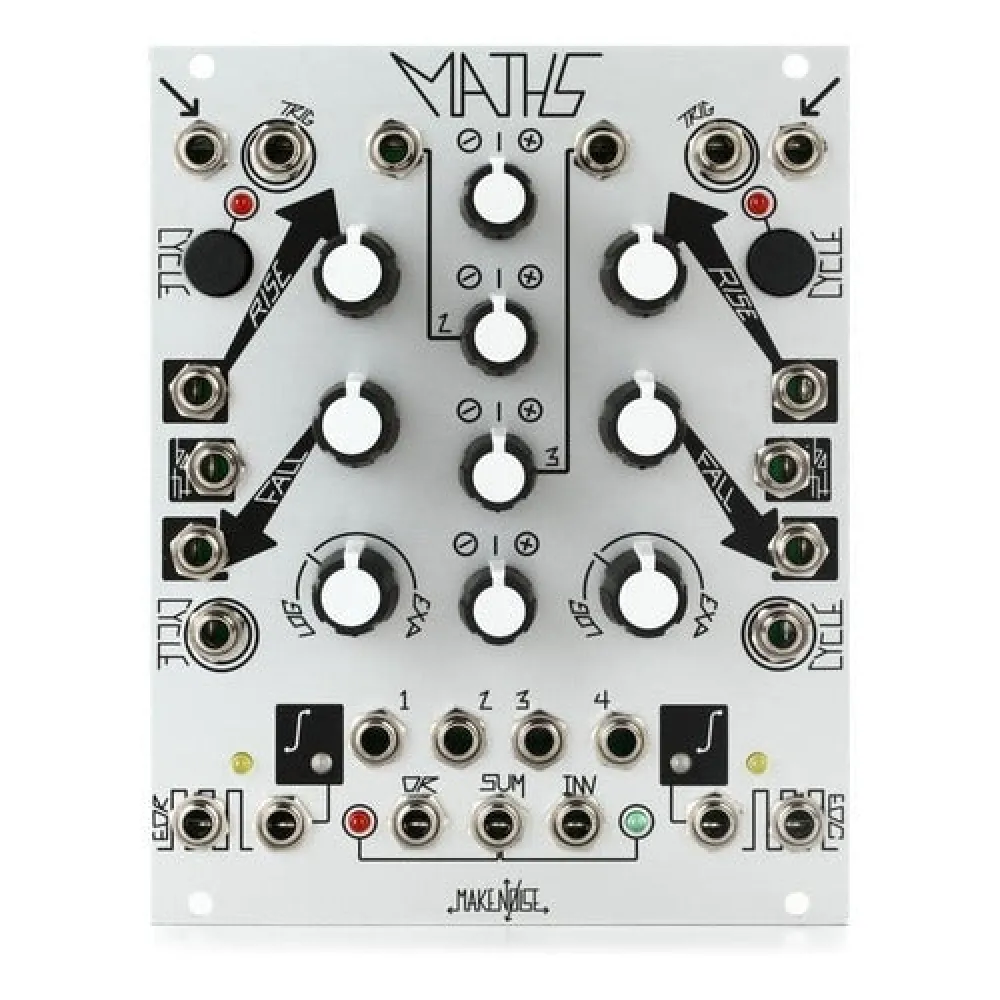
Make Noise describes Maths as an analog computer designed for musical purposes. In practice it is the module that brings movement to a modular system: it generates the envelopes and LFOs that open a filter, make a VCA breathe or move the pitch of an oscillator, and it also processes and combines the control voltages already present in a patch.
Key Features
- Voltage-controlled envelopes and LFOs with cycles ranging from 25 minutes up to 1 kHz, reaching audio rate
- Linear, logarithmic or exponential response curves, triggered or cycling continuously
- Lag, slew and portamento processing of control voltages so one note can glide smoothly into the next
- Add, subtract and invert signals, combining up to 4 control signals into more complex modulation
- Amplify, attenuate or invert an incoming signal to set how much it modulates
- Rhythmic event functions: clock division, pulse delay and End of Rise and End of Cycle outputs for chaining events
- Four channels: channels 1 and 4 are function generators, while channels 2 and 3 scale, amplify and invert signals and provide fixed offsets of plus or minus 10 V and 5 V with nothing patched
- All four channels meet at the SUM, inverted SUM and OR outputs